
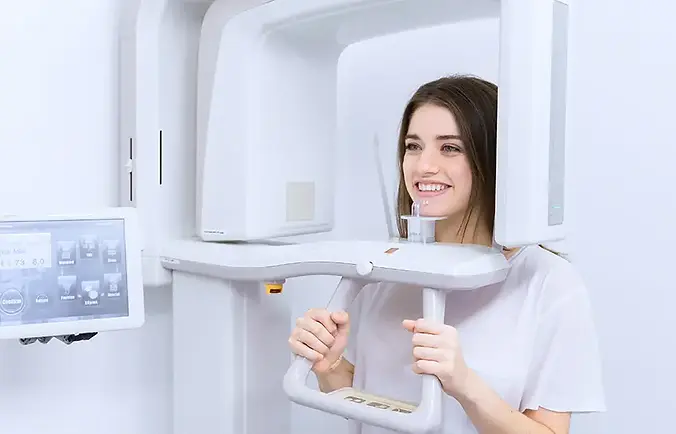
Cone Beam 3D Imaging
Cone Beam Computed Tomography (CBCT) is a medical imaging technique that uses a cone-shaped beam of radiation to capture detailed three-dimensional images of structures within the body, offering advantages over traditional 2D imaging by providing more detailed and accurate representations of anatomical structures.
What is Cone Beam 3D Imaging Used For?
-
Dental Implant Planning: CBCT allows dentists and oral surgeons to assess the bone structure and plan the optimal placement of dental implants.
-
Temporomandibular Joint Disorders: It aids in assessing the temporomandibular joint for the diagnosis of TMJ disorders.
-
Endodontics: It aids in visualizing the root canal system for accurate diagnosis and treatment planning.
-
Sinus and Nasal Imaging: CBCT is used to visualize the sinuses and nasal structures for diagnosis and treatment planning.
-
Orthodontics: It provides detailed images of the teeth, jaw, and surrounding structures, assisting in orthodontic treatment planning.
-
Surgical Planning: It´s crucial for planning and performing oral and maxillofacial surgeries, such as corrective jaw surgery and facial trauma reconstruction.
-
Impacted Teeth: It helps in locating and assessing the position of impacted teeth like Third Molars.
-
Oncology : CBCT can be used for treatment planning, helping to precisely target tumors and minimize damage to surrounding healthy tissues.

How should I prepare?
-
A cone beam CT examination requires no special preparation.
-
Prior to the examination, you may be asked to remove anything that may interfere with the imaging, including metal objects, such as jewelry, eyeglasses, hairpins and hearing aids.
-
Although removable dental work may need to be removed, it is advisable to bring these to your examination, as your dentist or oral surgeon may need to examine these as well.

Benefits of CBCT
-
The focused x-ray beam reduces scatter radiation, resulting in better image quality.
-
A single scan produces a wide variety of views and angles that can be manipulated to provide a more complete evaluation.
-
Cone beam CT scans provide more information that conventional dental x-ray, allowing for more precise treatment planning.
-
CT scanning is painless, noninvasive and accurate.
-
A major advantage of CT is its ability to image bone and soft tissue at the same time.
-
No radiation remains in a patient's body after a CT exam.
-
The x-rays used for CT scanning should have no immediate side effects.
Risks of CBCT
-
CBCT involves the use of ionizing radiation, it's important to minimize unnecessary exposure, especially in routine or repeated imaging. Inappropriate use or overuse of CBCT can lead to unnecessary radiation exposure. Healthcare professionals should carefully evaluate the clinical need for CBCT imaging and consider alternative imaging methods when appropriate.
-
Pregnant women should avoid exposure to ionizing radiation, as it may pose risks to the developing fetus. CBCT scans should be avoided or delayed unless absolutely necessary, and the benefits must be carefully weighed against the potential risks.
-
Proper shielding and collimation are essential to focus the radiation beam on the specific area of interest, reducing unnecessary exposure to surrounding tissues. Clinicians should ensure that proper protocols and safety measures are in place during CBCT scans.
-
Patients who undergo multiple imaging procedures over time may accumulate radiation exposure. Dental professionals should keep a record of a patient's radiation history and consider cumulative dose when recommending additional imaging.
